
A new report by GridLab, Kevala, and E3 outlines a roadmap for unlocking the potential of millions of customer-owned energy resources to improve affordability and grid reliability.
According to the report, California's path to affordable electricity rates begins in homes and driveways; the study offers recommendations on how millions of customer-owned energy resources can enhance grid operations across the state.
Authored by experts from the three energy research and consulting firms, the report—titled *Unlocking California’s Flexible Load*—argues that the dual challenges of skyrocketing electricity rates and the grid's increasing reliance on variable renewable energy can be addressed by leveraging "controllable resources": the millions of distributed energy resources located at customer sites throughout the state.
Among these controllable resources, the researchers identify electric vehicles and distributed energy storage as the most impactful technologies.
"Next-generation grid infrastructure already exists in our driveways, homes, and businesses," said Ric O'Connell, Executive Director of GridLab, in a statement. "The question isn't whether California has the resources, but whether our plans are designed to unlock their full value."
The authors state that the opportunity to utilize these resources is now viable due to the widespread adoption of advanced metering technology and the fact that these resources can be used for load management "without requiring constant changes in customer behavior or lifestyle."
They cite projections from the California Energy Commission (CEC) indicating that 9.7 million light-duty electric vehicles are expected to be on California's roads by 2036, representing over 110 GW of behind-the-meter capacity. A chart shows that by 2036, electric vehicles will represent over 110 GW of capacity, whereas planned utility-scale energy storage procurement stands at 31 GW:
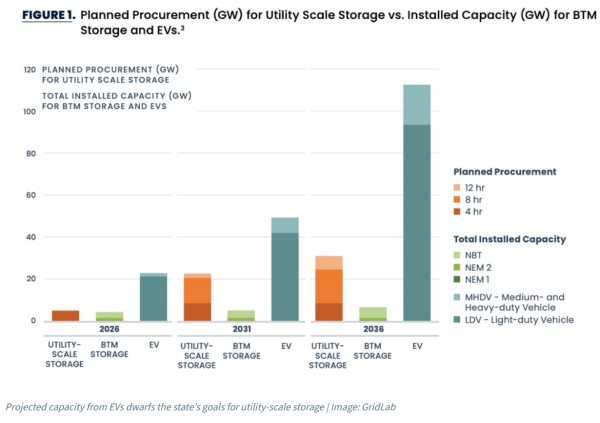
Projected EV capacity far exceeds the state's utility-scale energy storage targets | Image: GridLab
Researchers state that if these resources could provide power via vehicle-to-grid (V2G) capabilities and operate similarly to grid-scale storage, just 10% of these EVs would suffice to meet 30% of the state's cumulative utility-scale storage procurement target for 2036—provided the programs are designed correctly.
The authors note that past attempts to design grid-benefit programs utilizing distributed energy resources (DERs) have failed for various reasons, including compensating for enrollment rather than performance, requiring DERs to adhere to rules designed for wholesale generators, and avoiding programmatic reform in favor of layering on additional, overlapping processes without addressing the root issues limiting customer participation.
Looking ahead, the authors call for a set of streamlined, standardized, and performance-verified pathways that are strictly anchored to monetized avoided costs and advanced in tandem with retail rate reform. While acknowledging that an excessive focus on avoided costs might limit customer participation, they argue that the goal of improving energy affordability necessitates evaluating the services any such program provides to the grid against the direct costs of alternative utility investments, rather than considering potential societal benefits.
The authors conclude: "Most importantly, any new flexible load initiative must be structured to pay only for the incremental value associated with robustly measured performance, and must avoid exacerbating rate affordability pressures caused by NEM/NBT cost shifts."