
DC fast charging (DCFC) is the technology that allows you to charge an electric vehicle (EV) in 20-40 minutes rather than hours. It's fundamentally different from the AC charging you do at home.
Here's a breakdown of how it works, from the grid to your car's battery.
The Core Idea: Bypassing the Onboard Charger
The key difference between AC and DC charging is where the conversion from AC (Alternating Current) to DC (Direct Current) happens.
AC Charging (Level 1/2): Your home and the public grid supply AC power. Your EV has a built-in onboard charger that converts AC to DC to feed the battery. This onboard charger is limited in size and power (typically 7-11 kW, up to 22 kW for some premium models).
DC Fast Charging: The conversion from AC to DC happens outside the car, in the charging station itself. The station is essentially a massive, powerful external charger that feeds DC power directly to the battery, bypassing the car's smaller, slower onboard charger.
Step-by-Step Process of a DC Fast Charge
1. Grid Connection & Power Conversion:
The DC fast charging station is connected to a medium- or high-voltage electrical grid connection (often 480V AC three-phase industrial power).
Inside the large cabinet of the charging station, rectifiers and converters transform the incoming AC power into high-voltage DC power. This is the station's core function.
2. Communication & Handshake (The Digital Conversation):
When you plug in, before any high-voltage electricity flows, your car and the charger have a critical digital conversation using a protocol called CCS (Combined Charging System), CHAdeMO, or Tesla's NACS.
They verify the connection is secure.
They agree on the maximum voltage and current the car's battery can accept.
The car communicates its current state of charge (SOC), battery temperature, and other vital stats.
3. Power Delivery & Ramping Up:
Once the handshake is complete, the charger begins supplying DC power at the agreed-upon levels.
The charging process is managed by the car's Battery Management System (BMS). The BMS is the brain of the battery pack—it constantly monitors the health, temperature, and state of every cell.
The BMS continuously tells the charging station what voltage and current to supply.
4. The Charging Curve (Not a Flat Line):
This is the most important concept. DC charging is not a constant "fill-up." It follows an optimal charging curve to protect the battery and maximize speed.
Constant Current Phase (0% to ~50-80% SOC): The charger supplies maximum current (e.g., 350A or 500A), and the voltage rises steadily as the battery fills. This is the fastest part of the charge, where you gain miles per minute most rapidly.
Constant Voltage Phase (~80% to 100% SOC): To prevent damage as the battery nears full capacity, the BMS instructs the charger to hold a constant voltage and drastically taper down the current. This is why charging from 80% to 100% can take almost as long as 10% to 80%. It's recommended to only charge past 80% on road trips when needed.
5. Monitoring & Safety:
Throughout the session, the BMS and charger are in constant communication.
They adjust the charge rate based on battery temperature. If the battery gets too hot or too cold, charging will slow down or pause. (This is why many EVs have active battery thermal management systems).
Multiple fail-safes monitor for faults, ground issues, or communication errors and will immediately shut down power if a problem is detected.
6. Completion:
Once the battery is full (or you stop the session via the station's screen or app), the charger cuts off the DC supply.
A final communication confirms the session is complete, and you are billed based on energy delivered (kWh) or time connected.
Key Components Involved
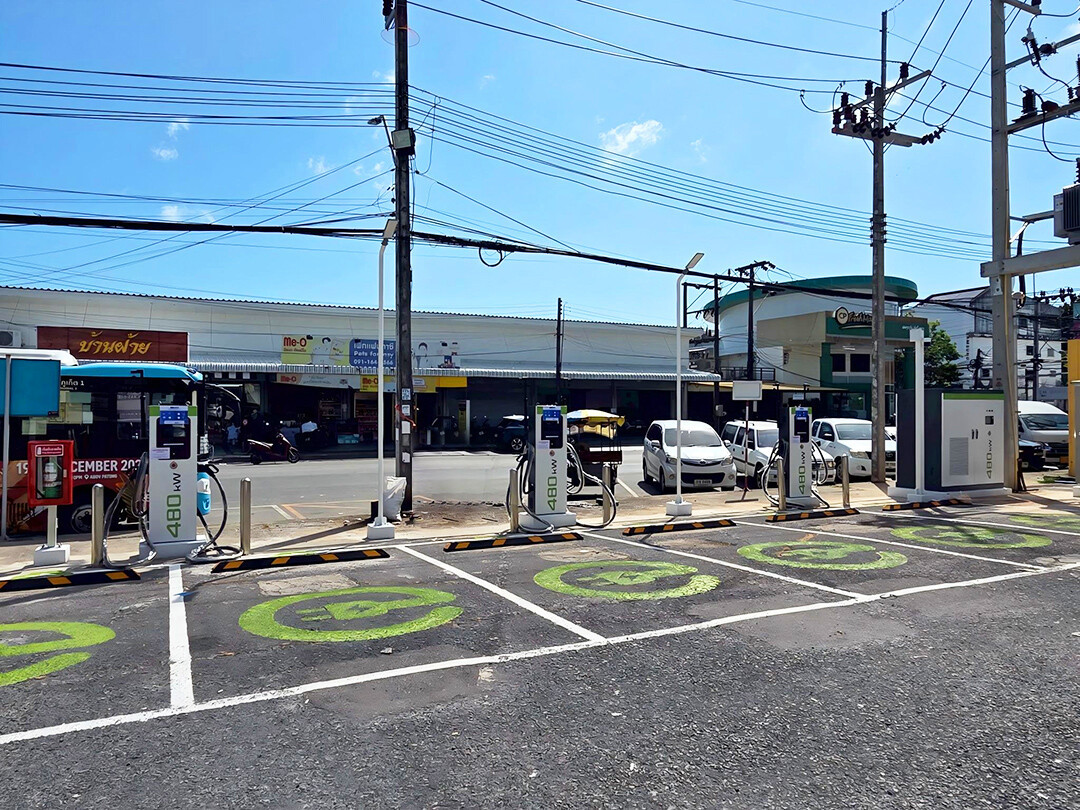
Charging Station ("The Dispenser"): Contains the heavy-duty power electronics (rectifiers, transformers, cooling systems) and the user interface.
EV Battery Pack: The high-voltage DC battery, typically 400V or 800V architecture in modern EVs.
Battery Management System (BMS): The critical onboard computer that governs the entire process to ensure safety and longevity.
DC Charging Port & Cables: These are much thicker and heavier than AC cables because they carry high-voltage DC current. They have liquid cooling inside to manage the heat generated.
Voltage Matters: 400V vs. 800V Architecture
400V Systems: The current standard for most EVs. A 350 kW charger delivering maximum power to a 400V battery requires extremely high current (amps), generating more heat and requiring heavier, liquid-cooled cables.
800V Systems: Used by vehicles like the Hyundai Ioniq 5/6, Kia EV6, Porsche Taycan, and Lucid Air. For the same power (kW), an 800V system only needs half the current. This means:
Less heat generation.
Lighter, more manageable cables.
Potentially faster charging, especially in the constant current phase.
Related Posts
- ISO 15118 and OCPP for V2G: How EVs, Chargers and Charging Networks Communicate
- 8,833 Battery Electric Vehicles Registered in Malaysia in August 2026
- Why 1.2MW Charging Requires Smart Energy Management
- What Is the Megawatt Charging System (MCS) and How Does It Work?
- Teison Is Heading to IAA TRANSPORTATION 2026!